Articles
F5 BIG-IP load balancer certificate automation
Automate the complete certificate lifecycle at the F5 TLS termination point and on backend web servers while keeping application traffic encrypted through the DMZ.
{{anchor:Introduction}}
In this architecture, an F5 BIG-IP LTM terminates the client-side TLS session at the virtual IP (VIP) and establishes a separate TLS connection to the backend web servers. As a result, certificates must be managed at two layers: the F5 for browser-facing TLS and the backend web servers for the encrypted server-side connection. DigiCert Trust Lifecycle Manager can coordinate both layers with purpose-built automation components. DigiCert sensors manage supported F5 appliances, while DigiCert agents manage certificates on supported backend web servers.
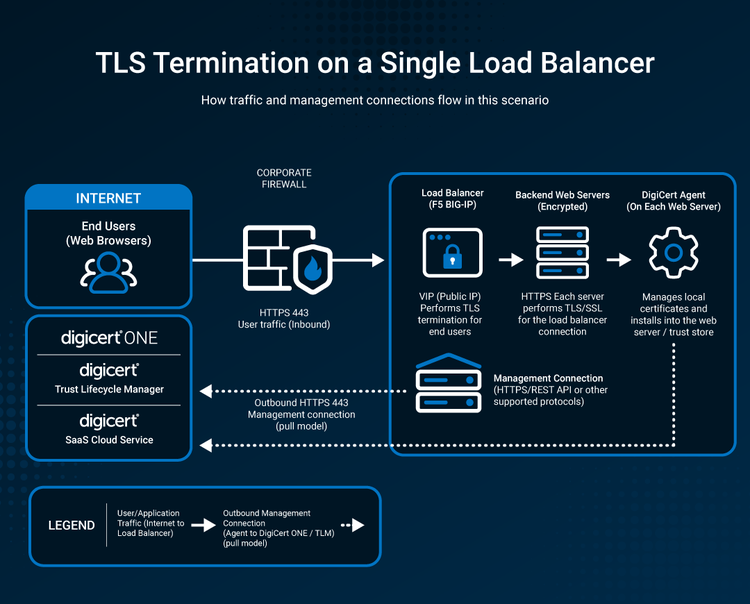
The DigiCert sensor initiates outbound HTTPS connectivity to Trust Lifecycle Manager and uses an internal management connection to the F5. End-user HTTPS traffic goes through the firewall to the F5 VIP, where the client-side TLS session terminates. The F5 then initiates a separate HTTPS connection to backend web servers.
{{anchor:Why it matters}}
Why this scenario matters
F5 BIG-IP LTM appliances often sit in front of multiple applications and virtual IPs, making certificate health critical across the entire application path. In a TLS re-encryption architecture, organizations must manage certificates at two connection points: the public-facing TLS session between users and the F5, and the backend TLS session between the F5 and the web servers.
If the F5 certificate expires or is deployed incorrectly, users may be unable to establish the public TLS session. But even when the F5 certificate is valid, an expired, untrusted, or misconfigured backend certificate can still break the F5-to-web-server connection.
As a result, the key design question is not just whether the F5 certificate can be renewed. Organizations must also account for backend certificate discovery and automation, F5 Client SSL and Server SSL configuration, high-availability behavior, trust chains, hostname or SNI requirements, and the network access required by each automation component.
{{anchor:How DigiCert fits}}
How DigiCert fits
Sensor-based F5 automation
A DigiCert sensor runs on a separate host and manages the F5 connector. No DigiCert agent is installed on the F5 appliance.
Agent-based backend web-server automation
DigiCert agents installed on supported backend servers can discover, renew, and deploy the certificates used for the F5-to-server TLS connection.
Separate certificate lifecycles
The F5 certificate secures the browser-facing TLS session. Backend certificates secure the separate server-side TLS session. TLM can manage both without treating them as a single certificate endpoint.
Central visibility and policy
TLM centralizes inventory, automation profiles, lifecycle-event status, and deployment verification so teams can distinguish issuance from installation.
{{anchor:At a glance}}
At a glance
- Environment: a supported F5 BIG-IP LTM appliance receives inbound HTTPS at the VIP, terminates the client-side TLS session, and then establishes a separate HTTPS connection to backend web servers. Both the F5 and backend web servers use certificates.
- DigiCert deployment model: Trust Lifecycle Manager SaaS with an on-premises DigiCert sensor for the F5 connector, plus a DigiCert agent on each supported backend web server whose certificates are managed by TLM. Sensors and agents use outbound HTTPS connectivity to TLM.
- Typical validation approach: validation depends on the certificate type and issuing CA. Public certificates may require automated domain control validation; backend certificates can use an appropriate public or private trust model based on the F5 Server SSL configuration and organizational policy.
- What to verify before deployment: supported F5 and web-server versions, sensor and agent system requirements, F5 management connectivity, backend agent connectivity, F5 Client SSL and Server SSL behavior, trust chains, SNI/hostname requirements, key storage, HA design, DNS/DCV needs, and certificate automation profiles.
{{anchor:Technical implementation details}}
Technical implementation details
This scenario contains two certificate-management paths. The F5 connector and DigiCert sensor manage certificates presented by the F5 VIP. DigiCert agents can manage certificates installed on supported backend web servers.
The F5-to-backend HTTPS connection also depends on the F5 Server SSL configuration and the trust relationship for the backend certificate. Exact F5 versions, management ports, sensor and agent hosts, proxy settings, credentials, key-storage options, DNS integrations, certificate profiles, SNI behavior, and HA settings can vary by deployment. Confirm current prerequisites and procedures in DigiCert and F5 documentation before implementation.
- F5 BIG-IP LTM integration guide — review the supported F5 connector architecture, sensor requirements, discovery, and certificate automation workflow for the load-balancer certificate layer.
- Managed automation solution — review DigiCert agent-based certificate automation for supported IIS, Apache, NGINX, IBM HTTP Server, and Tomcat systems used as backend web servers.
- Agent system/network requirements — verify outbound HTTPS connectivity, supported host operating systems, proxy options, and the requirement to run agents on appropriate systems.
- Sensor and network connectivity requirements — verify outbound HTTPS connectivity, supported host operating systems, proxy options, and the requirement to run sensors on appropriate systems.
- DNS integrations for domain validation — understand when TLM can use DNS integrations to automate domain validation for public certificate lifecycle events at either certificate layer.
{{anchor:FAQ}}
Frequently asked questions
{{anchor:Next steps}}
Ready to evaluate your environment?
See how DigiCert Trust Lifecycle Manager can support certificate lifecycle automation across your enterprise.