Articles
How DNS-01 validation works
{{anchor:DNS-01 challenge}}
What is a DNS-01 challenge?
DNS-01 proves control of a domain through DNS rather than through a web server. It is the standard ACME challenge for wildcard identifiers. It is often a strong fit when the certificate target is behind a firewall, load balancer, CDN, or other architecture where HTTP validation would be difficult. For a domain name, the ACME server provides a unique challenge token. The ACME client combines that token with information derived from its ACME account key, hashes the resulting key authorization with SHA-256, and publishes the base64url-encoded digest in a DNS TXT record.
The validation record is placed under _acme-challenge.<domain>. For example, validating www.example.com uses a TXT record at _acme-challenge.www.example.com.
DigiCert queries DNS for the validation name. If one of the returned TXT values matches the value expected for that ACME challenge, domain control validation succeeds. After the challenge reaches a final state, the client should remove the temporary validation record unless the workflow intentionally retains other unrelated TXT values at the same name.
{{anchor:How DNS-01 works}}
How DNS-01 works, step by step
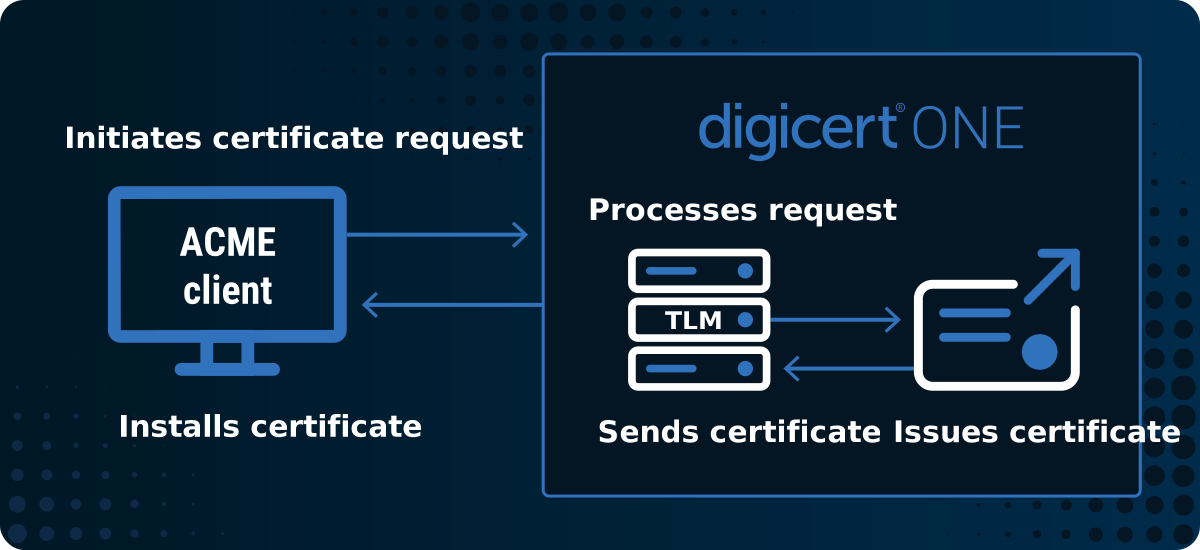
- The ACME client requests a certificate containing one or more DNS identifiers.
- DigiCert returns an authorization object with a DNS-01 challenge for each identifier that requires dynamic ACME validation.
- The ACME client calculates the DNS-01 validation value from the challenge token and its ACME account key.
- The client or an integrated DNS automation component publishes the value as a TXT record at the required _acme-challenge name.
- After the DNS change is externally resolvable, the client tells the ACME server that the challenge is ready.
- DigiCert resolves the validation name from its validation infrastructure, including required multi-perspective checks for publicly trusted TLS issuance, and confirms that an expected TXT value is present.
- If DCV succeeds and any other applicable validation, CAA, policy, or approval requirements are satisfied, certificate issuance can proceed.
- After the challenge completes, the ACME client should clean up the temporary TXT value according to the client and DNS-provider workflow.
{{anchor:A strong fit}}
When DNS-01 is a strong fit
- Wildcard certificates. DNS-01 is the ACME challenge used for wildcard identifiers; HTTP-01 does not support wildcard validation.
- Private or firewalled certificate targets. The target server doesn't need to expose TCP port 80 for ACME validation because the proof is published in DNS.
- Load-balanced, CDN-fronted, or multi-server services. Validation is independent of which application backend receives user traffic.
- Centralized certificate automation. A controlled automation service can manage DNS validation for many certificate consumers, provided DNS privileges are carefully scoped.
- Environments where public DNS is programmable and auditable through a supported API or automation integration.
DNS-01 is not automatically the better choice. If a single web server can safely and predictably answer HTTP-01, that method can avoid granting an ACME workflow write access to DNS. The appropriate choice depends on architecture, privilege boundaries, DNS-provider capabilities, and operational ownership.
{{anchor:Validation}}
DNS caching, TTL, and validation timing can affect validation
Other factors can also affect validation timing, including provider replication, secondary authoritative servers, DNSSEC, and split-horizon DNS.
- Do not treat 60-300 seconds as a universal required TTL. Choose a TTL that matches your DNS platform and change-control model.
- If the _acme-challenge name or RRset was queried before the TXT value existed, negative caching can matter; the SOA negative-cache settings may influence how long an NXDOMAIN or no-data answer persists.
- Lowering a TTL immediately before a renewal does not force resolvers that already cached the previous TTL to discard it early. If you want a lower TTL for automation, establish it before you depend on it.
- Use the ACME client or DNS plugin's propagation check where available, and validate against public authoritative or external DNS views rather than only an internal corporate resolver.
- Multiple TXT values can legitimately coexist at the same _acme-challenge name. ACME validation succeeds when an expected value is present; cleanup should remove only the value created for the completed challenge.
{{anchor:Wildcard certificates}}
Wildcard certificates and the base domain
DNS-01 is required for ACME wildcard validation. With DigiCert, validating the DNS-01 record at _acme-challenge.example.com can satisfy validation for both example.com and *.example.com when they are part of the applicable request. HTTP-01 cannot validate a wildcard identifier.
{{anchor:Supplemental resources}}
Supplemental resources
- DigiCert: ACME DNS-01 challenge
- DigiCert: Complete DNS-01 challenges for ACME
- DigiCert: DNS-01 challenge for wildcard domains
- DigiCert: ACME domain validation behavior
- DigiCert: Supported DCV methods
- DigiCert: Persistent DNS TXT record DCV
- RFC 8555: Automatic Certificate Management Environment (ACME)
- CA/Browser Forum: Latest TLS Baseline Requirements
{{anchor:FAQ}}
Frequently asked questions
{{anchor:Next steps}}
Ready to evaluate your environment?
See how DigiCert Trust Lifecycle Manager can support certificate lifecycle automation across protected web servers and the rest of your enterprise certificate estate.