AI Trust

Trust AI with proof, not assumption

Use cryptographic trust to control AI agents, protect models, and verify content, so you can prove what’s real at internet scale.
Read the white paper Explore DigiCert ONE

Trust AI with proof not assumption
AI agent

Control AI agents and MCP servers

Give every AI agent a verifiable identity and enforce what it can access and do.

AI model

Protect model integrity

Ensure AI models are signed, verified, and run only in trusted environments from build to runtime.

Certified

Prove authenticity

Verify where content comes from and whether it has been altered with tamper-evident provenance.

AI breaks traditional trust

AI agents, models, and content operate at machine speed—without built-in ways to verify authenticity, protect integrity, or enforce control.

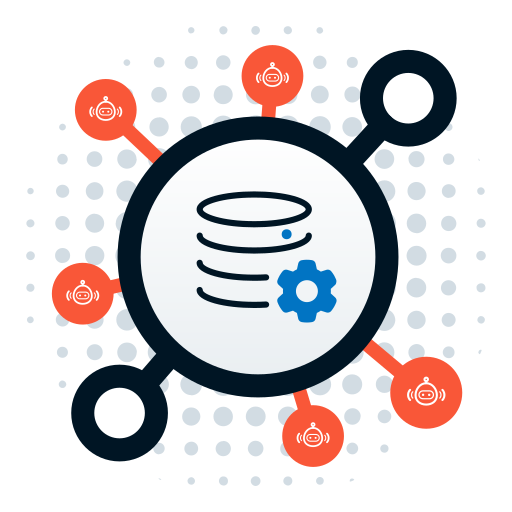
Agents act without clear identity or control

Autonomous AI agents interact with systems and data, often without clear identity, governance, or auditability.

Explore AI Trust Manager
Agents act without clear identity or control

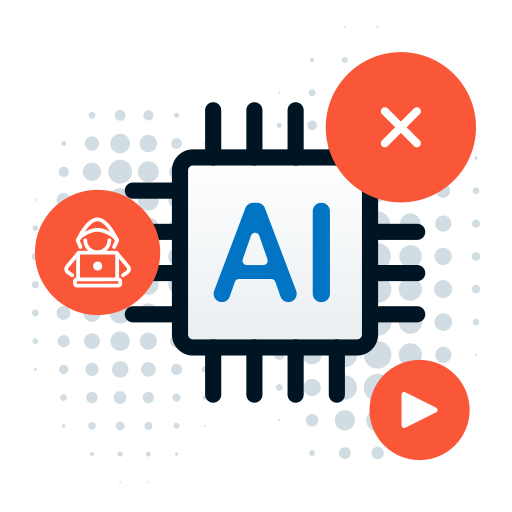
Models introduce new attack surfaces

AI models can be tampered with, misused, or run in untrusted environments without clear integrity guarantees.

Join our AI Model Trust preview
Models introduce new attack surfaces

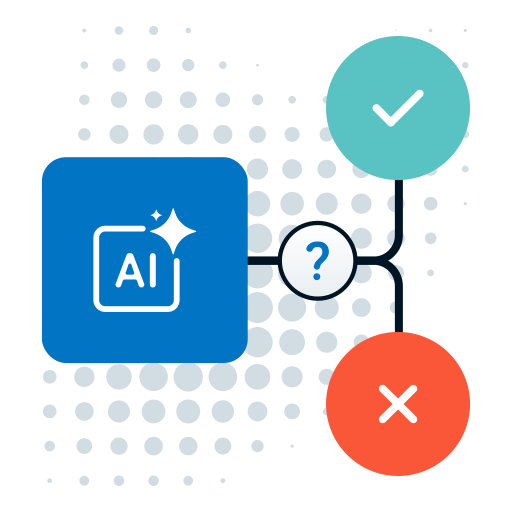
Content can't be trusted at face value

AI-generated and manipulated media makes it difficult to verify what is real, creating reputational and legal risk.

Explore Content Trust Manager
Content cant be trusted at face value

AI identity you can prove and control

Document signed verified generic

Reduce reputational risk

Prove the authenticity of digital content to limit misinformation and brand damage.

Database

Protect models and data

Ensure models remain untampered and data stays secure across training and runtime.

Controls settings

Enforce accountable AI behavior

Bind AI agents to identity, policy, and human ownership so each action is auditable.

Scale

Scale AI with confidence

Apply trust controls across content, models, and agents without adding complexity.

Establish trust across AI systems

Govern AI agents, protect models, and verify content with cryptographic proof—so trust is proven across every AI interaction.

Govern agents

Enforce AI agent boundaries

  • Issue strong, cryptographic identities to AI agents
  • Enforce policy-based access and actions at runtime
  • Track agent activity and relationships across systems for full auditability

Enforce AI agent boundaries
Protect models

Verify model integrity everywhere

  • Sign and validate models at every stage from training to deployment
  • Run models only in trusted and attested execution environments
  • Maintain verifiable lineage to detect unauthorized changes or reuse
Verify model integrity everywhere
Secure content

Enable verifiable content provenance

  • Sign digital content at the point of creation to establish origin and integrity
  • Track content across distribution to maintain a verifiable chain of custody
  • Detect tampering with cryptographic verification at any consumption point

Establish verifiable content provenance

Why leaders trust DigiCert for AI Trust

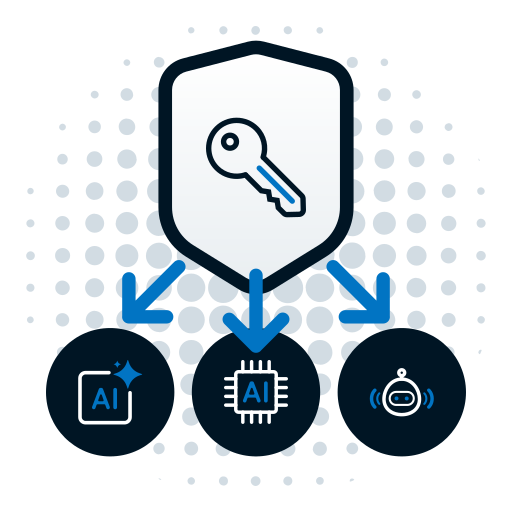
One cryptographic foundation

Extend proven PKI-based trust to AI systems across content, models, and agents—so authenticity, integrity, and identity work from the same foundation.
One cryptographic foundation

Built for machine scale

Verify and manage trust across high-volume AI systems operating at machine speed, without losing policy control or auditability.

Built for machine scale

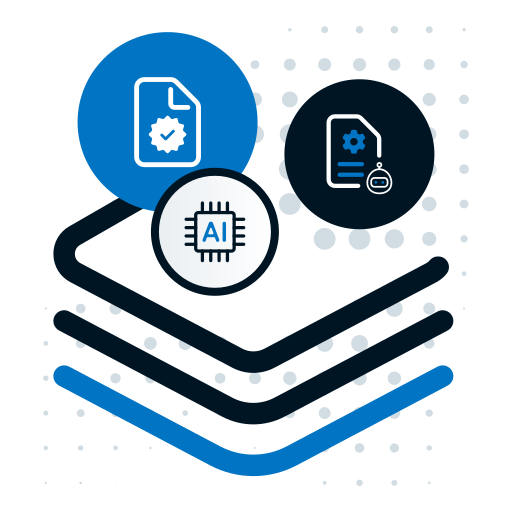
Unified platform approach

Combine content trust, model integrity, and agent governance within DigiCert ONE to reduce fragmentation and manage AI trust in one place.
Unified platform approach ai trust

Why DigiCert

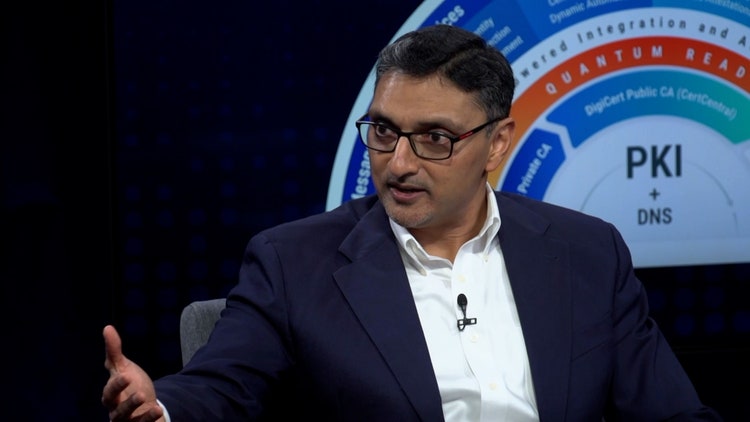
Amit answers: What is AI Trust?

Before you put an AI agent to work, it needs a cryptographic passport. Watch tech journalist Larry Magid interview DigiCert CEO Amit Sinha about how to verify an agent, define what it can access, and control what it can do.
Amit-AI-Trust-video-still.jpg
/content/dam/digicert/dynamic-media/videos/signed_EDS-digicert-amit-larry-cube-cut-cc.mp4

"Enterprise AI buying has moved from trust to proof. Buyers are ranking verifiable security controls as their top priority and name unverifiable vendor claims as their top frustration. Cryptographic identity, attestation, and revocation for agents, models, and MCP servers are the machinery that produces this proof, which in turn produces trust, and DigiCert is pointing the identity discipline the internet already runs at scale at exactly that problem.”

Grace Trinidad

IDC - AI Security and Trust

idc-logo.webp

Quote

Insights to strengthen your AI security strategy

White paper

The New Trust Architecture for AI

Read the white paper

Guide

How to Trust AI Agents

Get the guide

Press release

DigiCert Introduces New AI Trust Framework

Read the press release

Blog

How Agentic AI Is Redefining Enterprise Trust

Read the blog

Blog

Reimagining Digital Insurance in the Age of Intelligent Systems

Read the blog

Analyst report

IDC Marketscape Excerpt for Certificate Lifecycle Management 2026

Get the report

Frequently asked questions

What is AI trust?
AI trust is confidence, supported by verifiable evidence, that AI systems and their outputs are authentic, untampered, accountable, and operating as authorized. It applies across AI agents, models, MCP servers, and AI-generated content.
Why is AI trust important?
AI systems increasingly access sensitive data, connect to external services, and act autonomously at machine speed. Without verifiable trust, organizations cannot reliably determine what AI systems are operating, who owns them, whether they have been altered, or whether their actions are authorized.
How can organizations establish verifiable trust in AI systems?
Organizations can establish verifiable AI trust by discovering their AI assets, assigning clear ownership, and using cryptographic proof to verify identity, integrity, and provenance. Short-lived credentials, runtime attestation, policy-based authorization, revocation, and tamper-evident audit records help maintain that trust throughout the AI lifecycle and across organizational boundaries.
How can organizations secure and establish trust in AI agents?
Organizations should treat AI agents as non-human workloads rather than human users. Each agent should receive a cryptographically verifiable identity connected to its owner, lineage, policies, and permitted actions. Short-lived credentials, runtime attestation, continuous authorization, activity records, and automated revocation help organizations control agents across systems and organizational boundaries.
How can organizations verify AI model integrity?
Organizations can verify AI model integrity by cryptographically signing approved models and validating their signatures and hashes throughout development, distribution, and deployment. Model manifests, bills of materials, trusted execution environments, and runtime attestation provide additional evidence that the correct model is running in an authorized environment without unauthorized modification.
How can organizations verify the authenticity and provenance of AI-generated content?
Organizations can attach cryptographically signed Content Credentials to AI-generated or human-made content at creation. Standards such as C2PA allow those credentials to identify the source, record relevant edits, and provide a tamper-evident history that others can independently verify. Content provenance verifies origin and integrity; it does not determine whether the content itself is factually accurate.
What is the difference between AI trust, AI security, and AI governance?
AI security protects AI systems and data against threats such as unauthorized access, tampering, theft, and misuse. AI governance establishes the policies, responsibilities, and processes that guide how AI is developed and used. AI trust is the resulting confidence, supported by verifiable evidence, that AI systems are authentic, secure, accountable, and operating according to those policies.
How does DigiCert help organizations establish trust in AI?
DigiCert extends its PKI, DNS, identity, signing, and attestation capabilities to AI systems and content. DigiCert AI Trust Manager helps organizations discover and govern AI agents, models, and MCP servers using verifiable AI Agent Passports, policy enforcement, lifecycle controls, and revocation. DigiCert Content Trust Manager enables independently verifiable content provenance using C2PA standards. Together, these capabilities establish cryptographic trust across organizational boundaries and at internet scale.

Ready to elevate your AI Trust strategy?

Explore DigiCert ONE Talk to an expert

Ready to elevate your ai trust strategy