Wildcard certificates: one certificate for every subdomain
What is a wildcard certificate?
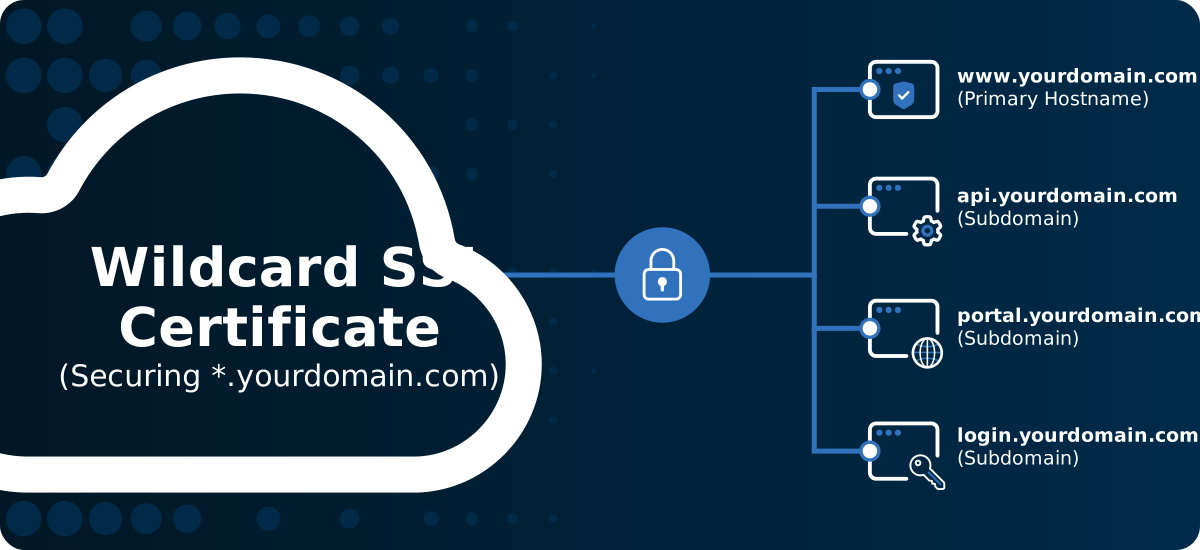
A wildcard TLS certificate contains a wildcard DNS identifier, typically in the Subject Alternative Name (SAN) extension. The wildcard character substitutes for a single DNS label. A wildcard TLS certificate can represent many hostnames at one DNS level with a single wildcard identifier such as *.yourdomain.com. That can reduce certificate sprawl and accommodate new first-level subdomains without changing the wildcard name. But wildcard coverage also increases the scope of a certificate and, if the same private key is distributed broadly, can increase the impact of key compromise or operational failure.
For *.yourdomain.com:
- www.yourdomainexample.com - covered
- api.yourdomain.com - covered
- portal.yourdomain.com - covered
- login.yourdomain.com - covered
- dev.api.yourdomain.com - not covered because it is two labels below yourdomain.com
Wildcard coverage is name coverage - not automatic deployment
A wildcard certificate does not automatically create, install, or configure a certificate on every subdomain. It simply allows the certificate to be valid for hostnames that match the wildcard pattern. The certificate and corresponding private key still have to be available at the TLS termination point that serves each hostname, unless TLS terminates centrally at a shared proxy, load balancer, CDN, or gateway.
Note: A wildcard can cover a hostname that did not exist when the certificate was issued, but the new service still requires a valid TLS deployment. Wildcard name coverage removes the need to add that first-level hostname to the certificate; it does not remove requirements for installation, binding, key protection, or validation.
When wildcard certificates are a good fit
- Many first-level subdomains belong to the same operational and security boundary.
- New first-level subdomains are created frequently and explicit hostname-by-hostname certificate changes would add unnecessary friction.
- TLS terminates at a small number of well-controlled gateways, load balancers, or reverse proxies, limiting how widely the wildcard private key must be distributed.
- The organization can automate renewal, deployment, and live-endpoint validation for every location where the wildcard certificate is used.
- The blast radius of revocation, expiration, misdeployment, or key compromise is understood and accepted.
When a wildcard is probably the wrong boundary
- Subdomains are owned by unrelated teams or have materially different security requirements.
- One wildcard would span internet-facing services, internal administrative services, development environments, or different application protocols without a strong reason.
- The same wildcard private key would need to be copied to a large number of independently administered servers.
- High-value services need independent key rotation, revocation, incident response, or HSM/KMS protection.
- You need names across unrelated base domains; explicit SANs or separate certificates are generally a better fit.
The real security risk is private key sprawl
The primary wildcard risk is not the asterisk itself. Risk increases when a certificate with broad name coverage is paired with a private key that is distributed across many systems. If an attacker obtains that private key, they may be able to impersonate any hostname within the certificate's wildcard scope, depending on the surrounding network and application controls.
If the same wildcard certificate and private key are copied to ten servers, a compromise of any one server can expose the shared key used by the others. This is why broad wildcard deployment can turn a local host compromise into a domain-wide credential incident.
Deploying wildcard certificates across multiple systems
There are two fundamentally different designs, and they should not be treated as equivalent:
- Reuse one certificate and private key on multiple endpoints. This is operationally simple but enlarges the key-compromise and coordinated-renewal blast radius.
- Issue separate certificates - potentially with the same wildcard identifier - using distinct private keys for separate endpoints or trust boundaries. This preserves wildcard name flexibility while improving key isolation, though it increases the number of certificate objects to manage.
DigiCert Trust Lifecycle Manager can centrally automate certificate lifecycle operations across supported web servers, network appliances, cloud services, and vaults. Agents manage supported server hosts; sensors and connectors manage supported network appliances and cloud services. Use the supported automation pattern for the actual TLS termination point rather than assuming every wildcard deployment should distribute one identical private key everywhere.
CAA and wildcard issuance
Certificate Authority Authorization (CAA) can place additional controls on wildcard issuance. The CAA issuewild property can specifically authorize or restrict CAs for wildcard certificates. Organizations using CAA should test and document the intended policy for both wildcard and non-wildcard names rather than assuming an issuewild record alone describes the entire order.
Shorter public TLS lifetimes increase the value of automation
Wildcard certificates are subject to the same public TLS lifetime limits as other publicly trusted TLS certificates. At publication time in August 2026, DigiCert limits newly issued public TLS certificates to 199 days. DigiCert's published roadmap moves to a 99-day maximum in early 2027 and a 46-day maximum in early 2029, subject to final implementation dates and current CA/Browser Forum requirements.
The shorter lifecycle does not make wildcard certificates inherently better or worse. It makes reliable automation, inventory, ownership, deployment validation, and key isolation more important because every certificate population will rotate more frequently.
Supplemental resources
- DigiCert: What is a Wildcard TLS/SSL Certificate?
- DigiCert: Wildcard TLS/SSL Certificates
- DigiCert: Complete DNS-01 challenges for ACME
- DigiCert: DNS-01 challenge for wildcard domains
- DigiCert: Supported DCV methods
- DigiCert: Persistent DNS TXT Record DCV
- DigiCert: Trust Lifecycle Manager managed automation workflow
- DigiCert: TLS/SSL certificate validity FAQ
Frequently asked questions
Ready to evaluate your environment?
See how DigiCert Trust Lifecycle Manager can support certificate lifecycle automation across protected web servers and the rest of your enterprise certificate estate.