In cybersecurity, the term “blast radius” describes how far damage spreads after an initial failure. The larger the blast radius, the greater the disruption.
When it comes to certificate outages, the blast radius is often far larger than organizations expect.
A certificate expires. A renewal is missed. A trust chain breaks. On paper, it looks like a localized technical issue. In reality, that single failure can ripple outward, disrupting authentication, halting applications, breaking integrations, and eroding customer trust.
Certificates sit at the heart of digital operations, and when they fail, the impact doesn’t stay contained.
The center of the trust ecosystem
Digital certificates power nearly every secure interaction in modern business. They enable TLS encryption for websites and APIs. They authenticate users, workloads, and devices. They secure software through code signing. They underpin zero-trust architectures and machine-to-machine communication.
In short, certificates are foundational trust infrastructure.
But they’re also dynamic, time-bound credentials. They expire. They depend on intermediate and root certificate authorities (roots of trust). They’re embedded across cloud platforms, Kubernetes clusters, CI/CD pipelines, mobile apps, IoT devices, edge systems, and partner integrations.
As organizations accelerate digital transformation, certificate volumes have exploded. Machine identities now vastly outnumber human identities, a trend that’s accelerating with agentic AI. At the same time, industry standards have shortened certificate lifespans, increasing renewal frequency.
The combination of scale, distribution, and shortened validity all increase the potential blast radius of any single failure.
How the blast radius expands
Certificate failures don’t degrade gradually. They fail decisively and loudly.
- Authentication attempts are rejected.
- Encrypted connections terminate.
- Applications refuse to launch.
- APIs stop responding.
What begins as an expired credential quickly becomes a systems-wide disruption.
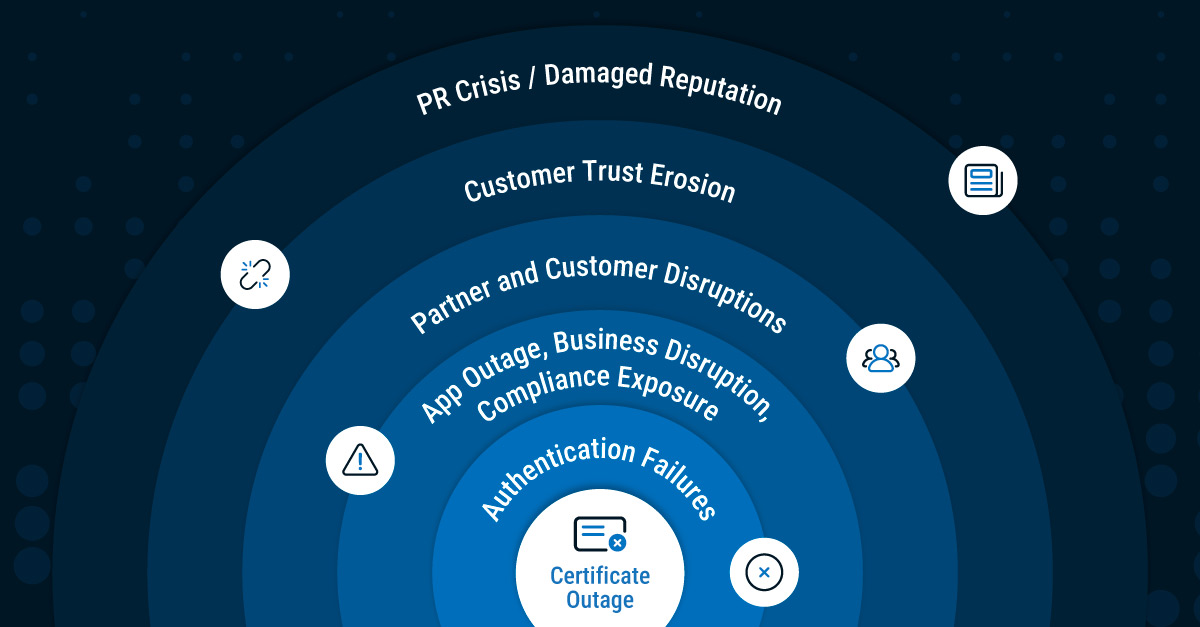
The blast radius expands in predictable ways:
- Upstream and downstream dependencies: A certificate used by one service may be relied upon by dozens of others. When it expires, dependent systems fail in ways that may not immediately point back to the root cause.
- Cross-team fragmentation: Certificates often span multiple teams—security, DevOps, infrastructure, application development. Without centralized visibility, no single team sees the full scope of impact.
- External ecosystem exposure: Customers, partners, suppliers, and connected devices may all rely on the same trust chain. A failure internally can quickly propagate outward.
Public incidents have repeatedly demonstrated this effect. Expired code-signing certificates have rendered widely deployed applications unusable. Root certificate expirations have disrupted embedded systems that failed to update trust stores. Authentication certificate lapses have interrupted connectivity for large-scale networks.
In each case, the technical issue was simple. The blast radius, however, was not. Isolating the root cause during the ensuing chaos was often far from straightforward.
From outage to business event
The real risk of certificate failure is not just operational but strategic.
When authentication fails, customers can’t log in. When APIs break, revenue-generating transactions stop. When partner integrations fail, contractual commitments are jeopardized.
The result is downtime, missed SLAs, support escalations, and reputational damage.
Because certificates underpin digital trust, their failure directly affects business continuity. What starts as an infrastructure problem can escalate into executive-level scrutiny within hours.
In a digital economy built on always-on services, trust and availability are inseparable. Expanding blast radii translate directly into business risk.
Why blast radii are growing
Several forces are increasing both the likelihood and impact of certificate-related incidents:
- Shorter certificate lifespans mean more frequent renewals and higher operational pressure.
- Hybrid and multi-cloud environments create siloes of certificate administration.
- Machine identity growth multiplies the number of certificates in circulation.
- Manual tracking processes introduce human error at scale.
Spreadsheets and calendar reminders were never designed to manage tens to hundreds of thousands of certificates across dynamic infrastructure. Without automation and centralized oversight, blind spots are inevitable.
And blind spots enlarge blast radii.
Designing to contain the blast radius
Reducing the blast radius of certificate outages requires proactive design, not reactive response. Certificates must be treated as mission-critical, continuously managed infrastructure.
Organizations need:
- Comprehensive discovery to identify every certificate across environments
- Automated issuance and deployment to eliminate manual gaps
- Centralized visibility and governance across teams and clouds
- Insight into dependencies to understand downstream impact
At DigiCert, we believe trust should be managed as a strategic asset. DigiCert® Trust Lifecycle Manager provides unified discovery, automation, and governance of certificates across hybrid and multi-cloud environments. By delivering visibility into certificate inventory and dependencies, Trust Lifecycle Manager allows organizations to detect risk early, before it expands.
Automation plays a central role. With policy-driven renewal and deployment workflows, certificates can be updated seamlessly, shrinking the window for failure. Instead of reacting to outages, teams prevent them.
Beyond TLS, DigiCert’s digital trust solutions secure devices, software, email, and machine identities—enabling organizations to manage trust holistically and reduce fragmentation across the ecosystem.
From reactive recovery to proactive resilience
Certificate expirations are inevitable. Expanding blast radii are not.
Organizations that continue to rely on fragmented, manual processes accept greater systemic risk as their environments scale. Those that implement automated, centralized PKI management contain failures before they propagate.
In modern digital infrastructure, resilience isn’t just about recovering quickly—it’s about preventing small issues from escalating at all.
Certificates sit at the center of your trust ecosystem. Managing them proactively is how you shrink the blast radius and protect uptime, revenue, and reputation in a world that depends on secure, authenticated connections.
Because when trust infrastructure fails, the impact spreads fast.
And containing that blast radius starts with managing digital trust the right way.
Featured Stories

DigiCert’s 2029 post-quantum infrastructure migration plan
.png)

Certificate lifecycle management reaches an inflection point
Subscribe to the blog
-

DigiCert is a global leader in intelligent trust, securing people, data, and devices with AI-powered solutions built to stop threats today and prepare for a quantum-safe future.
-



-
© 2026 DigiCert, Inc. All rights reserved.
Legal Repository Audits & Certifications Terms of Use Privacy Center Accessibility Cookie Settings