When the world went online, availability became the language of trust. The inaugural DigiCert RADAR Brief captures what that means in practice: tsunami-scale DDoS events, an industrial wave of automated attacks, and a DNS backbone under unprecedented pressure. Across DigiCert’s global network, the story that emerges is both simple and sobering—resilience has become the defining measure of digital credibility.
Attackers have learned to weaponize the infrastructure that keeps the internet running. They flood, fragment, and automate at a pace that tests even the most sophisticated defenses. For security leaders, this quarter’s RADAR data makes one truth unavoidable: Protecting availability is no longer just about downtime prevention. It’s about preserving trust itself.
The internet fights back
The RADAR data shows a pattern of escalation that’s redefining the threat landscape. What once came as brute-force disruption has evolved into choreography—precision strikes woven into floods of traffic designed to overwhelm and distract. It’s not one kind of attack anymore; it’s all of them, all at once.
These multi-layered assaults mark a shift in intent. Adversaries aren’t just looking to take systems offline—they’re probing the very seams of global connectivity. The goal is to erode confidence in the reliability of the internet itself. And in that environment, even a few seconds of disruption can ripple across entire economies.
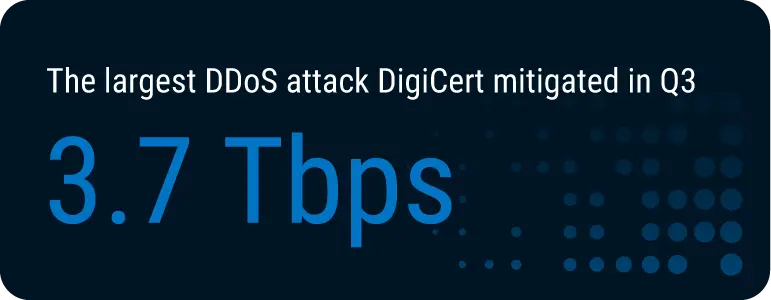
For defenders, this means rethinking scale as the baseline. Multi-terabit floods are no longer anomalies; they’re expectations. Resilience depends on the ability to absorb impact and adapt instantly, coordinating network, application, and DNS defenses so they move as one.
DNS under strain—the unseen heartbeat of trust
If DDoS is the visible attack surface, DNS is the quiet infrastructure holding everything together. The RADAR Brief reveals how even subtle anomalies in DNS traffic—misconfigurations, malformed queries, automated scans—can cascade into global performance issues.
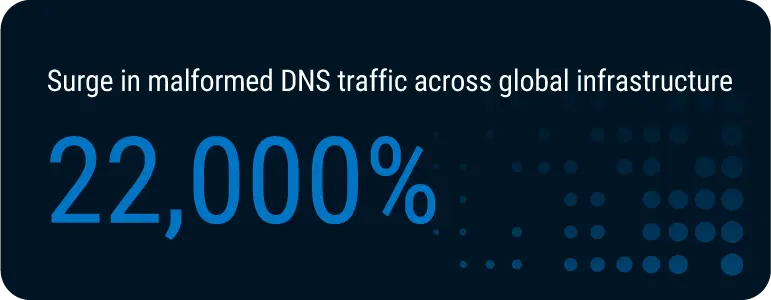
DNS isn’t just a technical utility; it’s a trust anchor. It dictates where data flows and how users connect. When it falters, so does every service built on top of it. The recent surge in malformed and anomalous DNS activity illustrates how fragile this backbone can be—and how much modern resilience depends on getting the fundamentals right.
The takeaway for security leaders is clear: DNS is no longer a background function. It’s the control plane for the digital enterprise. And maintaining its integrity is inseparable from maintaining customer confidence.
Rewriting the threat equation with automation
While the DDoS and DNS numbers tell one story of scale, automation tells another. The RADAR findings point to a threat landscape increasingly powered by bots that operate continuously, testing credentials, scanning for weaknesses, and attacking with mechanical precision.
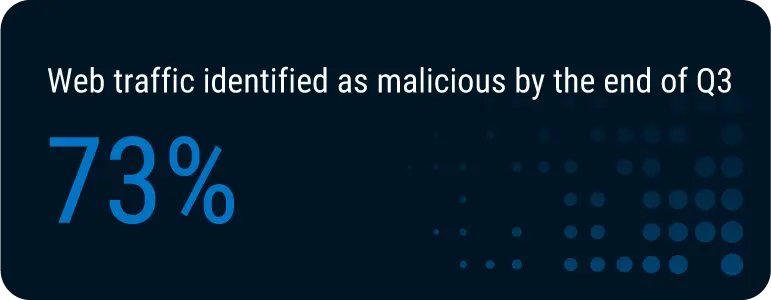
Automation has turned the internet into both target and weapon. What once required human effort now happens at industrial speed, allowing adversaries to experiment faster than defenders can respond. The shift isn’t only quantitative—it’s philosophical. Security teams must now defend against systems that learn, adapt, and replicate on their own.
Resilience in this environment means combining machine speed with human insight. It requires analytics that detect anomalies in seconds and architectures that can absorb automated abuse without human intervention.
Resilience: The new trust metric
What ties these signals together is coordination. The most resilient organizations are those that break down the silos between DNS, DDoS, and application protection. They unify visibility, treat telemetry as shared intelligence, and plan for scale as an operational constant.
As the RADAR Brief notes, attacks no longer happen in isolation—they move fluidly across layers of infrastructure, testing the boundaries of fragmented defenses. When one team can’t see what the other is mitigating, response time becomes the enemy.
The result is a shift in what trust means. Uptime has become evidence. Every uninterrupted transaction, every second of continuity, reinforces credibility with customers, partners, and regulators alike. Digital trust isn’t proven by certificates alone—it’s demonstrated by staying online when the pressure hits hardest.
Turning data into defense
The RADAR Brief offers more than a snapshot of threats. It’s a map of where resilience is headed—and how enterprises can adapt before the next wave hits. The takeaway isn’t fear; it’s readiness.
For security leaders, this quarter’s findings highlight a simple equation: Visibility drives resilience, and resilience sustains trust. Whether it’s fortifying DNS, modernizing DDoS defenses, or integrating web application firewalls into unified monitoring, the challenge ahead is coherence.
Explore the DigiCert RADAR Brief for deeper insights into how organizations worldwide are preparing for the next phase of resilience—and how to measure digital trust by what stays online.
Featured Stories
DigiCert’s 2029 post-quantum infrastructure migration plan
.png)
Certificate lifecycle management reaches an inflection point
Subscribe to the blog
-

DigiCert is a global leader in intelligent trust, securing people, data, and devices with AI-powered solutions built to stop threats today and prepare for a quantum-safe future.
-



-
© 2026 DigiCert, Inc. All rights reserved.
Legal Repository Audits & Certifications Terms of Use Privacy Center Accessibility Cookie Settings