Why Software Integrity Now Requires Proof, Not Promises
For years, software trust operated on a mix of reputation, internal controls, and good faith. Vendors described their security practices. Customers reviewed documentation. And in many cases, that was enough.
That environment has changed.
Today, organizations are being asked to demonstrate—not just describe—how their software is built, validated, and protected. Customers want transparency. Regulators want documentation. Security teams want evidence that integrity controls were applied before software reached production.
In this landscape, software integrity can no longer rely on assurances alone. It requires proof.
Why assurances are no longer enough
Internal controls still matter. Visibility into builds and strong signing governance remain foundational. But as software ecosystems have expanded, the audience for trust has expanded with them.
Software now travels across organizational boundaries in a continuous chain—from vendors to customers, into production environments, and across partner ecosystems that rely on shared platforms. Each handoff extends trust further downstream, often into systems that are mission-critical.
In that environment, trust becomes a shared responsibility rather than a private one. It’s no longer sufficient for a software producer to say, “We followed best practices.” Buyers want evidence of what was included in a release, how risks were evaluated, and whether integrity controls were applied consistently.
Regulatory pressure has reinforced this shift. Executive orders, industry guidance, and sector-specific requirements increasingly call for transparency in the software supply chain. Even when compliance isn’t the driving force, procurement teams and security leaders are asking more detailed questions before approving software for deployment.
The result is a new expectation: Software publishers must be able to substantiate their claims. Documentation, attestations, and verifiable artifacts are becoming part of the normal exchange between producers and consumers of software.
Assurances still have a place. But in today’s environment, they’re the starting point—not the finish line.
The role of SBOMs in proving integrity
One of the most practical ways organizations are responding to this shift is through the use of software bills of materials (SBOMs).
An SBOM functions like an ingredient list for a software build. It documents the components included in a release, along with relevant details such as versions and known vulnerabilities. That visibility allows buyers to evaluate risk based on facts rather than assumptions.
On its own, an SBOM improves transparency. When it’s signed or otherwise attested, it goes a step further, becoming evidence that the contents of a build were reviewed, validated, and formally acknowledged before release.
This is where the distinction between promises and proof becomes clear. A statement that software was scanned or validated is an assurance. A signed SBOM provides a verifiable artifact that can be shared, reviewed, and audited.
For organizations distributing software at scale, that difference matters.
Why integrity attestation is becoming a competitive advantage
As expectations shift, integrity attestation is moving beyond compliance and into competitive differentiation.
Procurement teams increasingly ask for evidence before approving new software. Security reviews are more detailed. In regulated industries, documentation is often mandatory. In others, it’s quickly becoming a best practice. Vendors that can provide clear, verifiable artifacts streamline those conversations and reduce friction in the sales cycle.
Attestation also builds confidence with existing customers. When organizations can demonstrate how a release was built, validated, and signed, they reduce uncertainty during upgrades and renewals. Transparency strengthens long-term trust.
In this environment, proof does more than satisfy auditors. It accelerates adoption, shortens review cycles, and signals maturity in how software integrity is managed.
Operationalizing integrity at scale
Visibility establishes what’s in a build. Governance controls how trust is applied. Attestation provides evidence that integrity was preserved. The real challenge is bringing those capabilities together in a way that works consistently across teams and pipelines.
That’s where an integrated approach becomes critical.
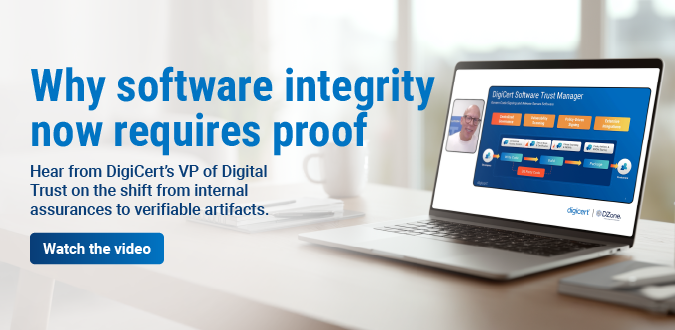
With a centralized platform like DigiCert Software Trust Manager, organizations can:
Generate and manage SBOMs within the build process: Produce consistent, shareable artifacts that reflect the actual contents of each release.
Sign and attest to software and related artifacts: Apply verifiable trust to builds and integrity documentation as part of a governed workflow.
Enforce signing policies automatically: Ensure that integrity controls are applied before release, not retroactively.
Maintain auditability across releases: Track who signed what, when, and under what policy conditions.
Bringing these capabilities into a single workflow reduces the gap between internal controls and external proof. Instead of assembling evidence after questions arise, organizations can generate it as a natural outcome of their development process.
From assurance to evidence
As software supply chains grow more interconnected and scrutiny increases, proof becomes part of the product itself. The ability to generate, sign, and share verifiable artifacts strengthens trust with customers, partners, and regulators alike.
If you’re looking to move from assurances to verifiable integrity, explore how DigiCert Software Trust Manager brings visibility, governance, and attestation together in a single, enforceable workflow—and make proof a built-in outcome of your development process.
Featured Stories
DigiCert’s 2029 post-quantum infrastructure migration plan
.png)
Certificate lifecycle management reaches an inflection point
Subscribe to the blog
-

DigiCert is a global leader in intelligent trust, securing people, data, and devices with AI-powered solutions built to stop threats today and prepare for a quantum-safe future.
-


-
© 2026 DigiCert, Inc. All rights reserved.
Legal Repository Audits & Certifications Terms of Use Privacy Center Accessibility Cookie Settings